Over the past week rising geopolitical tensions in Iran have introduced a significant risk premium into global energy markets, raising concerns about oil supply disruption, inflationary pressures, and broader macroeconomic spillovers. The duration and scope of hostilities will determine whether this event remains a temporary volatility shock or escalates into a sustained economic headwind.
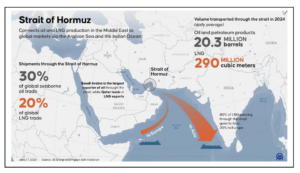
The reason why the Iranian conflict is significant is that 30% of the world’s oil and 20% of LNG flows through the Straits of Hormuz so disruption can have significant impact on the global economy. A prolonged disruption (beyond one month) risks a stagflationary supply shock. The market is currently pricing the turmoil to be short‑lived.
This is one of the largest supply disruptions. The US has had independence and a buffer but growth in shale is slowing and that could have long term structural implications. American consumer expenditures increased for almost everything except for energy in the last 2 decades; might not enjoy that trend going forward. Power generation and energy supply was a long term consideration already and forecasted prices were probably trending higher anyways because of AI demand, this conflict brought the timeline forwarded especially if sustained.
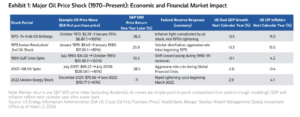
But the US is better able to weather the shock compared to most countries and also compared to our own history from the 1970s. The result is that both the growth and inflation impact from oil shocks has fallen over time. The US is much more energy efficient compared to 1980s in the wake of Iranian revolution. According to JP Morgan, while the US economy has grown more than 3x since 1980, it consumes nearly the same amount of oil. This is due to utilizing more fuel efficient vehicles and has urned into a largely services based economy and has new energy sources. As a result, it is not as vulnerable as in the 1970s.
Historically, oil tends to be very volatile when the geopolitical risk in the Middle East rises:

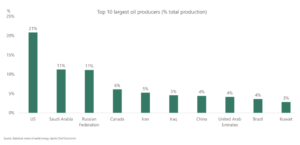 Another significant difference compared to the 1970s is that the U.S. is n ow the world’s largest producer of oil and natural gas, so the primary risk is higher prices, not a physical supply shortage.
The following are the economic and market impacts from major oil shocks since 1970:
The conflict and destabilization could go longer than expected; even if outright war stops, infrastructure has been damaged and restarting facilities takes time even for things like aluminum facilities. The Red Sea can help stabilize a bit, but Houthis in Yemen are anti-Saudi and an Iranian proxy and have shown willingness to interfere throughout that route. Asia and Europe are going to be affected and governments already looking to curb demand like Philippines encouraging remote work to reduce power consumption. This goes for both oil and LNG while US and Canada have self-sufficiency buffers for now.
Measures are being taken to blunt the supply shock. The International Energy Agency (IEA) has asked member states to release 300-400 mn barrels of oil from their strategic reserves. It is estimated that the members hold 1.2 bn barrels of oil. Both Japan and Germany announced that they will release some of their reserves. The US might ease Russian oil restrictions in order to increase the effective supply. In addition, it appears that China has received 12 mn barrels of Iranian oil through the Straits of Hormuz since the conflict began which should also ease pressure on global supplies.
During times of heightened geopolitical risk (particularly related to oil), uncertainty tends to cause markets to price escalation risk in bursts, keeping volatility elevated as investors reassess energy supply risk. The risk of stagflationary shock often results in the following financial market effects:
- Stronger U.S. dollar due to safe‑haven flows
- Equity market declines (with the US outperforming international markets)
- Wider credit spreads
- Higher interest rates as inflation worries trump growth concerns
- USD appreciation
The market turbulence caused by events in the Middle East is occurring against a positive economic backdrop. The US economic growth figures are solid. ISM Manufacturing PMI in February had its first back-to-back expansionary ISM readings since September 2022 while the ISM Services PMI Index reached its highest level since July 2022. Moreover, industrial production and durable goods results were solid and capex investment continues to be strong. Because growth is solid and inflation is above target, we expect that the Federal Reserve will keep monetary policy unchanged at next week’s FOMC meeting.
We came into this year having an outlook of inflationary growth. The positive economic growth backdrop has driven a very strong earnings season which wrapped up last Friday. 4Q-2025 S&P 500 earnings growth came in at 14%, which is outstanding. Despite the market volatility, the S&P 500 is only 4% away from its all-time high. Due to an outlook of higher inflation, we have also been cautious on assuming interest rate risk, recommending a duration in the 3-5 year range. Due to higher inflation expectations, since the conflict began the 10 Yr US Treasury yield has risen 25 bps, which is a significant upward move in a short period of time.
Even if the impact of an oil shock lasts several months, the supply disruption can keep inflation high for some time. The longer the conflict drags on, particularly if there is more significant damage to energy infrastructure in addition to constrained shipments through the Strait of Hormuz, the global economy could be at risk of a more prolonged energy supply shock. Due to elevated uncertainty, economic impacts from military conflicts have tended to have a medium term impact:

When geopolitical shocks occur the market has historically fallen for a few weeks immediately after the event and then recovers a few weeks later. As the graph above shows, generally the market is up a year later. It is important during these times not to overreact to the sentiment driven sell-off, rely on the strength of asset allocation and stick to the long term investment plan.
DISCLAIMER
Important Information and Disclosures
This document is confidential, is intended only for the person to whom it has been provided and under no circumstances may a copy be shown, copied, transmitted, or otherwise given to any person other than the authorized recipient without the prior written consent of WE Family Offices LLC (“WE”). WE is under no obligation to update the information contained herein. This material does not consider the specific investment objective, financial situation, or particular needs of any person.
The views, opinions and recommendations expressed here are subject to change without notice, are for information purposes only and should not be considered as investment, tax or legal advice, or a recommendation or offer of any security, asset, or service for sale. WE and its representatives are not your investment advisers unless you and WE have entered into a written advisory services agreement. Information contained herein has been obtained from sources we believe to be reliable, but we do not guarantee its completeness or accuracy.
Certain statements contained herein may constitute “forward-looking statements” under the U.S. federal securities laws. Without limitation, words such as “outlook”, “anticipate”, “believe”, “could” “expect”, “may” and “would” are indicative of forward-looking statements. Due to various risks and uncertainties, actual events or results or the actual performance may differ materially from those reflected or contemplated in such forward-looking statements. Opinions and estimates offered here constitute our judgment and are subject to change without notice and will not be updated, as are statements of financial market trends, which are based on current market conditions. Certain hypothetical market situations herein are based on historical data. Past performance of an asset, asset class, or strategy, is not indicative of future results.
In accordance with the rules of Treasury Department Circular 230, any information in this presentation pertaining to federal taxation and using such terms such as “tax planning” is not intended or written to be used and cannot be used by
you or any other person, for the purpose of (i) avoiding any penalties that may be imposed by the Internal Revenue Code, and (ii) promoting, marketing or recommending to another party any transaction or matter addressed herein.
This presentation does not constitute the provision of investment, legal or tax advice to any person. Please consult with your tax advisor regarding any taxation implications of the information presented in this presentation.