A Month Into the Conflict: What Has Actually Changed?
When the conflict with Iran first escalated, markets reacted with fear and uncertainty. A month later, the nature of the shock has changed. What began as a volatility event is evolving into an inflation event, and the data is starting to reflect this.
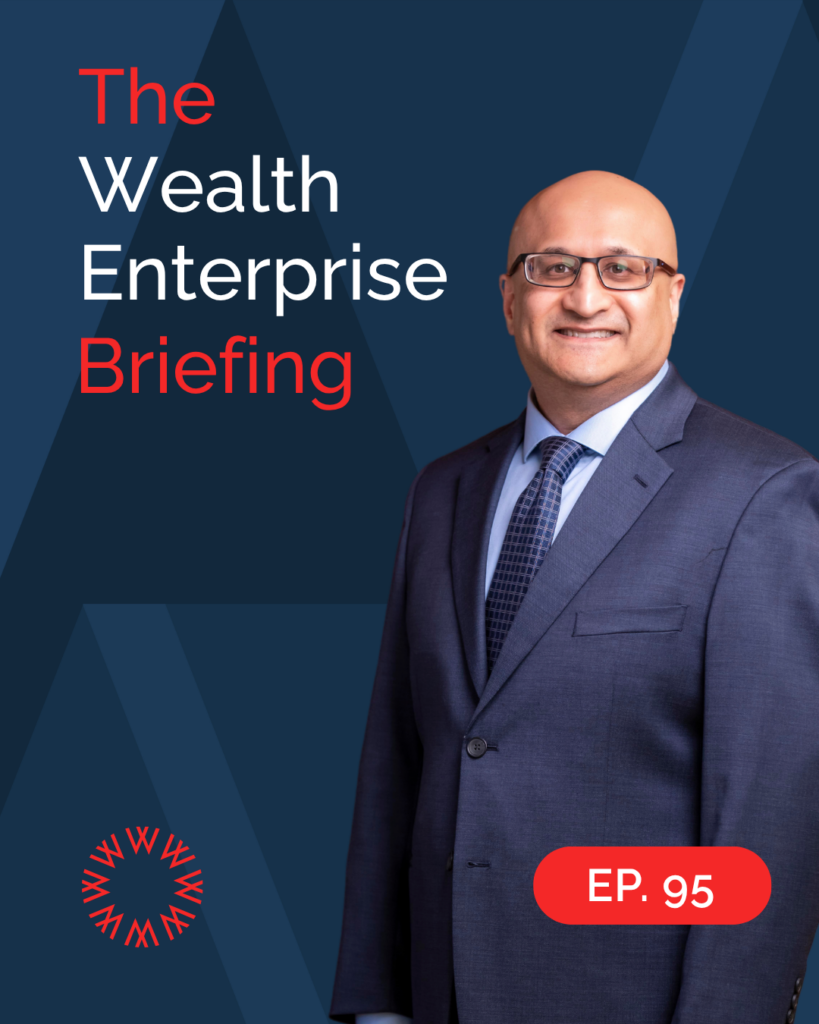
In this follow-up flash episode of The Wealth Enterprise Briefing, Managing Partner Michael Zeuner is again joined by Senior Investment Manager Sam Sudame to take stock of where things stand one month in and what it means for portfolio positioning.
They discuss:
Why oil rising from $65 to $98 a barrel has pushed the Fed to revise its inflation forecast higher
How yields moved 50 basis points in three weeks — and why bonds have not been the haven investors expected
Why markets have shifted from pricing two rate cuts to a 50% probability of a hike
Why energy stocks and natural resources have been the standout diversifiers
What three possible outcomes for equities look like from here — and why the stalemate scenario may be the most underappreciated risk
Why staying at target equity exposure remains the right call for long-term investors
Our team is continuously monitoring these developments and will share further insights as they become available. We encourage you to contact us directly to review how these market shifts may influence your specific portfolio strategy.
Important Information:
The Wealth Enterprise Briefing contains our current opinions and commentary, which are subject to change without notice. The Briefing is distributed for informational and educational purposes only and does not consider the specific investment objective, financial situation or particular needs of any recipient. Information contained herein has been obtained from sources we believe to be reliable, but we do not guarantee its completeness or accuracy. The information in the Briefing is not a recommendation of any security, and should not be relied upon as investment, legal or tax advice. Please consult with your investment, legal and tax advisors regarding any implications of the information presented in this presentation.
Transcript
Michael Zeuner:
Welcome to the Wealth Enterprise Briefing. Hi, everyone. Welcome to the Wealth Enterprise Briefing. I’m Michael Zeuner, one of the managing partners at WE Family Offices. I’m joined today by a familiar voice, Sam Sudame, our global head of macro, and we are going to discuss the most recent developments in the war with Iran and how that’s affecting capital markets and what the implications are for investors.
Michael Zeuner:
So welcome, Sam. Thanks for joining me. Let’s start with, we last talked about this about ten days ago. Please give us an update from your perspective on what’s transpired over those ten days and where we sit today.
Sam Sudame:
Sure. So thank you, Michael. So since our previous call for the markets, the conflict is transforming from a volatility shock based on emotion to an inflation shock. So when we first spoke at that time, there was a lot of fear and uncertainty facing the markets. And in that call, what we were looking for was the duration and scope of the conflict.
Sam Sudame:
But since that time, the flow of energy has slowed meaningfully through the Straits Of Hormuz, And the physical infrastructure has been struck, including gas fields in Iran and Qatar, and this has raised the severity. And without knowing the actual goals of the conflict, we also do not know about the duration either. But what we have seen is that over the past month, the price of WTI oil has risen basically 50% from $65 a barrel to around $98 a barrel today. Now if that conflict continues, the energy price shock could cause inflation to rise. In fact, last week, the Federal Reserve in its most recent summary of economic projections raised its forecast for 2026 inflation to rise from 2.4% to 2.7%.
Michael Zeuner:
Okay, Sam. So what we’re seeing clearly a month in is the specter of inflation not really being a specter, but becoming a reality, higher inflation than would have been expected prior to the war. And I have to imagine the first place that that really has impacted would be the bond market. And let’s talk about why that’s the case and, again, what the implication is for investors with their bond portfolios.
Sam Sudame:
Sure. So higher inflation is raising the spectrum of inflation rising. And as a result, it has already had a significant impact on yields. So in the past three weeks, The US ten year yield has gone from 3.96% to 4.45%, about 50 basis points. And that is a very large move in such a short period of time.
Sam Sudame:
And this has caused bonds to fall during a time of higher geopolitical risk. Ordinarily, we would think that geopolitical risk, one would flee to US bonds for flight to safety. But because of those higher yields, US Treasury bonds have been hit. And the market has now priced out the expectation of Fed rate cuts. So about a month ago, the market expected two rate cuts from the Federal Reserve.
Sam Sudame:
Now because of the specter of higher inflation, it is starting to price a 50% probability of a rate hike this year. And the Fed needs to raise rates to keep inflation expectations from rising.
Michael Zeuner:
Okay. Or potentially raise rates is what the market is suggesting. So we’ve been talking about inflation even before the war. We talked about being in a period of inflationary growth, and now with the war, inflation is creeping up given the increase in energy prices. And so we’ve been talking about how important it is for investors to keep the interest rate exposure that they have in their fixed income portfolios under control, to keep what’s called duration, which is a measure of interest rate risk, to keep it on the low to intermediate side.
Michael Zeuner:
And clearly that advice still holds in this environment. Okay. Let’s move though, Sam, and say that if bonds weren’t the asset class that provided relief in this kind of an environment like we might have expected barring the inflation shock, what asset classes have acted as a diversifier in this environment?
Sam Sudame:
So what has acted as a diversifier has been energy related stocks. So with energy prices rising, that has benefited those type of stocks because the cause of this conflict is energy. With higher prices, those particular stocks have done well.
Michael Zeuner:
And I would imagine, Sam, it goes beyond energy stocks, but it also goes to energy itself. So investors who have exposure to natural resources, commodities, particularly oil, have seen that portion of their portfolio zig while the rest of the market, particularly the bond market, has zagged. Now let’s go to the equity markets. So far, we have seen an increase in volatility in the equity markets. But what’s your perspective on, a, what’s happened in the equity markets to this point, and b, what the outlook could be for the future?
Sam Sudame:
So coming into this year, the strategy was one of inflationary growth, which is positive for equities. And we have seen profit growth expectations for this year improve. We’ve seen valuations improve. But equities are now starting to become more volatile. The reason is as this conflict continues, the inflationary shock can then lead to a growth shock.
Sam Sudame:
So higher interest rates should cause economic growth to slow and cause financial conditions to tighten. This would cause profit growth to fall and stocks would be vulnerable to another leg down. So this situation is extremely fluid. And what I’m looking for, again, continues to be the severity and duration of the conflict. And the stock market looks like it could break either way.
Sam Sudame:
So if the conflict continues, for example, striking energy infrastructure, stocks could fall much more. If the conflict ends, energy infrastructure remains intact and the Straits Of Horn moves open, stocks could rebound because we still have, again, those attractive valuations and earnings growth. But if the conflict is more stalemated and drags on, oil prices can continue to rise as passage through the Straits Of Hormuz remains impaired and starts causing an energy shortfall. So this scenario has a negative time value aspect to it.
Michael Zeuner:
What do you mean by negative time value, Sam?
Sam Sudame:
So as time increases and nothing happens, we kind of have that stalemate. The price of oil starts to rise because oil’s energy is not flowing through, which means whatever stockpiles people have of energy start to run down.
Michael Zeuner:
Okay. So we have a scenario with the equity markets where, number one, it’s always impossible to predict the future, but in this particular environment, you’ve laid out two or three outcomes that could have very different implications on the equity markets. Now, as a long term investor, putting aside the emotions of volatility and how difficult it is to think long term, particularly in an environment like this, what would be our thinking with equity exposure given those divergent possible outcomes with no clear view of what’s likely?
Sam Sudame:
So for a long term investor, the geopolitical risk, as you mentioned, causes the short term volatility. But when we look at the long term fundamentals, which will drive returns over that longer term horizon, say five or ten years, you’re seeing The US with an extremely productive economy. We have very powerful technology companies which continue to drive a lot of value, which continue to be driven by the AI theme. And as AI becomes further adopted, productivity rates will continue to rise. This is very positive for both the economy and markets.
Sam Sudame:
In addition to that, we see corporate and household balance sheets that are solid. As a result, the secular outlook for The US economy and markets is still very positive.
Michael Zeuner:
And therefore staying neutral, I presume, in terms of equity exposure to one’s long term target is the order of the day. You agree with that?
Sam Sudame:
Yes. And it’s very important to keep our eyes on that long term target.
Michael Zeuner:
Okay. So keep an eye on the short term, keep an eye on things as they develop, particularly inflation, the impact on supply of energy and energy prices, and stay tuned for more. Thank you, Sam. I appreciate your time.
Sam Sudame:
Thank you, Michael.
Disclosure:
The Wealth Enterprise Briefing is for informational and educational purposes only and does not consider the specific investment objectives, financial situation, or particular needs of any listener. The information in the briefing is not a recommendation of any security and should not be relied upon as investment, legal, or tax advice.
The Wealth Enterprise Briefing highlights the latest trends in investment strategies for ultra-high-net-worth families.
Join host Michael Zeuner, founder and managing partner at WE Family Offices, for interviews with industry experts about financial news and investment topics impacting enterprising families.
Subscribe
Michael Zeuner
Founder & Managing Partner
Fraud Alert
Impersonation fraud is becoming increasingly common across the financial industry, and we want to help our contacts stay alert.
WE Family Offices does not send unsolicited investment, partnership, or capital-deployment proposals. If you have received an email of this nature referencing our employees, it did not come from us. Our only official domain is wefamilyoffices.com.
Please do not reply, click any links, or share any information.