Is the Private Credit Selloff a Signal or a Distraction?
Private credit has faced a wave of negative headlines recently, touching on fraud concerns, software sector risk and questions about how these vehicles handle redemptions. For investors with existing allocations, it has been easy to wonder whether something more fundamental is shifting.
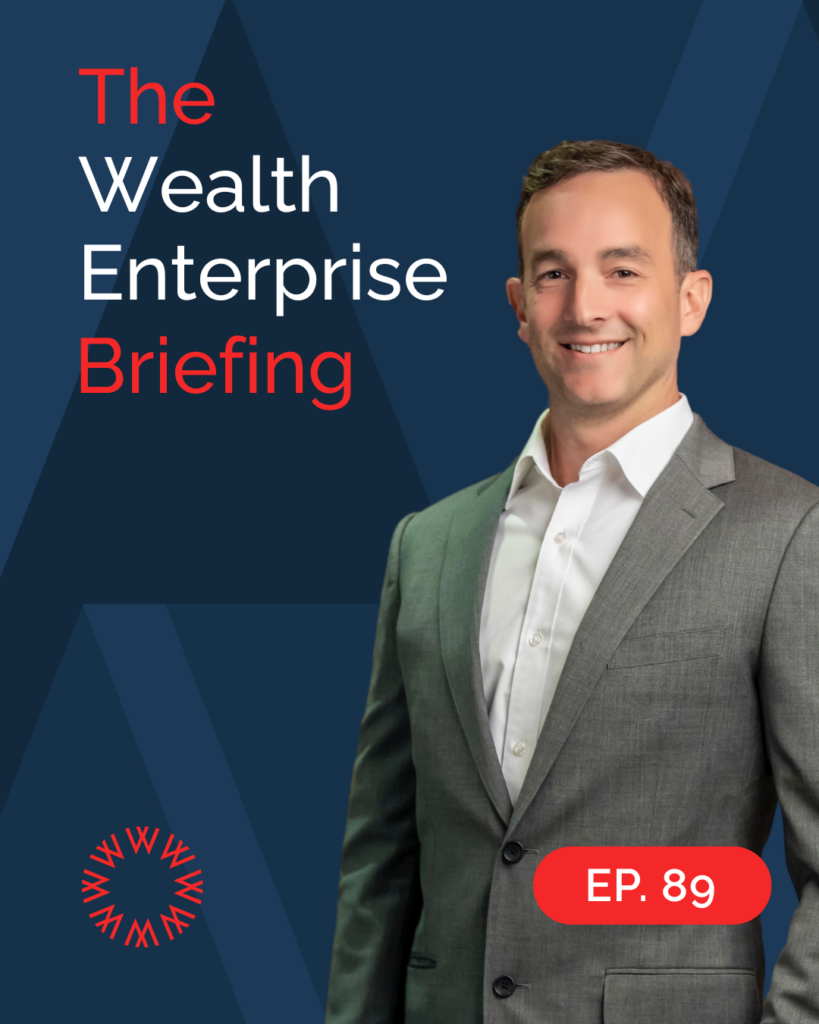
In this episode of The Wealth Enterprise Briefing, Michael Zeuner and Deputy CIO Matt Farrell examine what is actually behind the recent volatility, how the structure of private credit vehicles works in practice and whether the core thesis remains intact. Their view is that despite the noise, fundamental credit quality is holding up and the opportunity still rewards a disciplined, diversified approach.
They discuss:
Why the recent fraud headlines are not the whole story on credit quality
How the structure of public and private BDCs can create a misleading picture of underlying risk
What a high-profile redemption story actually revealed about how these vehicles are designed to work
What the current data is showing about the health of private credit portfolios
Why where you sit in the capital structure matters more than headlines suggest
How diversification remains the most important tool for managing risk in private credit today
For anyone with existing private credit allocations or those considering new commitments, this conversation offers an in-depth look at what the recent headlines do and do not mean for the long-term role of private credit in a portfolio.
If you’d like to talk through how private credit fits into your current allocation, please contact us.
Important Information:
The Wealth Enterprise Briefing contains our current opinions and commentary, which are subject to change without notice. The Briefing is distributed for informational and educational purposes only and does not consider the specific investment objective, financial situation or particular needs of any recipient. Information contained herein has been obtained from sources we believe to be reliable, but we do not guarantee its completeness or accuracy. The information in the Briefing is not a recommendation of any security, and should not be relied upon as investment, legal or tax advice. Please consult with your investment, legal and tax advisors regarding any implications of the information presented in this presentation.
Transcript
Michael Zeuner:
Welcome to the wealth enterprise briefing. Hi everyone. This is Michael Zeuner, one of the managing partners at we family offices, and thanks for tuning into the wealth enterprise briefing. I’m joined today again by Matt Farrell, our deputy CIO, and we’re going to revisit a topic that we talked about some months ago, but that continues to stay in the news. In fact, it has accelerated in terms of how much discussion there is in the news about the topic, which is private credit. And as we record Matt, there have been some new developments in the private credit markets. There’s been another significant default, and there’s just a lot of discussion about the private credit space. Can you help us make sense of what’s really going on beyond the headlines? I think the media tends to paint private credit all with one brush, and I know you’ve been doing a really deep look at the space, and I think it merits a much more nuanced and thoughtful conversation, and perhaps just all private credit is headed for a difficult time. So Matt, welcome and give us your thoughts please.
Matt Farrell:
Yeah, thanks. I would frame it by maybe three different things going on, or three different things that’s been in the news, maybe starting with the first and that’s some defaults. And we touched on this another podcast, but there was another one, actually, today, over in Europe. And the three things had three common characteristics, and that was fraud, you know, the double pledging of collateral. So these are one off events, and I would not characterize it as credit quality per se. It’s just downright fraud. So I think we have to isolate these cases, and they make for good headlines, but I think we can just set those aside for now. The second category is we’ve seen a massive sell off and public BDCs, a lot of the public equities, and it’s raised concern about private BDCs, and that’s the software as it relates to AI. So you have a lot of specialist software companies that, as Claude specifically, releases plugins and AI agents. The view is that these software companies are going to become antiquated and suffer. And so we’ve seen a massive sell off everywhere, from public equity to public BDCs, which are senior loans, and then down into private credit.
Michael Zeuner:
And the issue there, Matt is I understand it is that the software companies have borrowed very significantly from BDCs. And so the question is, will those companies have the earnings power to pay back the loans that they borrowed from the BDCs?
Matt Farrell:
So for my research, I see roughly 10 to 15% of BDCs having exposure to software. Obviously, that can range from a lot more to a lot less, but just to put a number out, I’d say 10 to 15% which is meaningful. And the second point is, a lot of these software companies are valued based on what’s called ARR annualized, recurring revenue. So maybe they’re not even profitable. If they’re younger companies, they’re just in hyper growth mode. And so if there’s any kind of stress, then they may not have the earnings to offset continue to pay interest on the loans. So those are the two categories, and maybe just one more thing on the second, just private equity in general has had a lot of software and tangential plays with software. So IT services, you know, software as a service. All of that’s kind of being bucketed together.
Michael Zeuner:
And let’s go back one second, Matt, because you use the term BDC and then you further nuanced it by talking about public versus private BDCs. What’s the difference between the two, and how does that factor in understanding the risk and the exposures.
Matt Farrell:
Yeah. So the difference is simply, one is public and one is private. So a public BDC is publicly traded and is going to have what we call equity beta. And so that means, as the as the equity markets move a certain amount of movement in the underlying BDC is going to be associated with the equity movement. So that’s, that’s essentially equity beta. And so what happens is, you’re going to see that volatility mark to market on a daily basis. And so you can actually see the decline. You know, some BDCs are trading at a 15% discount to their net asset value, just because of these, you know, headlines and perceived credit quality. Conversely, if you look at private BDCs, the loans are often shared between vehicles, so the same exact loan can be in a public versus private vehicle. But what you won’t see is that daily mark to mark movement, and this has been a point of controversy as it relates to valuations of these loans. Loans, because some are marking more appropriately than others, but you just won’t feel that day to day movement, and it’s marked on a quarterly basis, so that’s effectively the difference. So the third category, I would say, is the vehicles, and the structure of the vehicles. We saw headlines that a large BDC sold some loans in the market to pay redemptions for investors who wanted their money back. The terms of the vehicle can vary by vehicle, but generally speaking, there’s a 5% redemption quarterly that. And so what that means it could be a very long time before you get 100% of your money back. The first lever that they can pull to pay you back is incoming subscriptions that they get from other investors, and then they can pay out redemptions for the investors that want to get out if they’re not raising capital, then, you know, it’s cash. And then if that’s insufficient, it’s going to be potentially selling loans. If they want to, they don’t have to again, because it’s 5% and so what we saw was a large BDC went to market, sold a handful of loans to several counterparties, generally considered institutional counterparties, and the pricing they were able to sell those at were 99.7 cents on the dollar, so very close to their par value. But so that made a big headline, and my view is actually the structure worked. You know, there wasn’t a fire sale of assets that impacted the investors, which that wish to remain invested. At the same time, they’re being a pretty good partner and granted redemptions for investors that wanted to get out. Because, again, you should go into these vehicles, assuming that could take you years to get your money back. So I don’t really see it as that big of a deal. I think actually the structure worked, and they protected the remaining investors while granting some liquidity.
Michael Zeuner:
So let’s then go back to fundamentals. Matt, why would an investor invest in a BDC or a private credit vehicle? What are they hoping to accomplish? And Has anything changed about that fundamental thesis with these headlines?
Matt Farrell:
So the reason investors find these attractive is they generally spit out fairly attractive income, and historically it’s ranged from 250 to about 350 basis points. So two and a half to 3% premium of over what we would compare in the public markets. So bsls, known as broadly syndicated loans, are generally in public markets, and you can get a premium, an illiquidity premium, over the public markets historically. And so a combination of that cash yield component and the illiquidity premium over public markets, is why an investor would consider private markets.
Michael Zeuner:
Has anything changed about that thesis, given what’s going on in the headlines?
Matt Farrell: 10
Not as of today. So the data is going to be quite lagged. You know, we’re just starting to see some q4 data come out from end of 25 and what I’m seeing is the credit fundamentals are actually still sound, non accruals, which means the underlying borrower has stopped paying the loans back, is less than 1% it’s, I think it’s about 40 basis points, which is below the long term 1% average. So so far, borrowers are generally paying back their loans. Now there’s another metric that we look at called payment in kind known as pick, and we’ve covered this in the past, but there’s two different kinds of pick. There’s good pick, bad pick, good pick could be established at the onset of a loan so that you’re not paying cash coupons. It’s just being added to the balance of the loan. And they do that to not kind of strangle the cash and allow a company to grow. If you have a favorable outlook of the growth of the company, you could set pick at the onset that’s considered good pick. Bad pick is if you set out initially as a cash pay loan, and throughout the course of the loan, they’re maybe run into a headwind or just cash strapped in underway, unable to pay back the loan. And then you can toggle to pick, and that’s considered bad pick, and that’s because they’re viewed as a credit risk of being able to pay back the loan. So by rule of thumb, is less than 10% pick is considered, and what we’ve seen this, pick has been creeping up. It’s roughly about 8% now across a population of BDCs that we track, another consideration we should talk about is capital structure. Remember, these are generally senior loans, as opposed to common equity or subordinated debt. And what that means is, if there’s a default or some kind of bankruptcy, if you’re a senior lender, you’re top of the capital structure, so you’re senior to the others which are subordinated to you. So if there’s losses, there’s subordinated people. Pieces are going to incur those losses before you. So historically, there’s been recovery rates, and it can vary throughout time. But just because there’s a default doesn’t mean you lose 100% of your investment, right? So I think the point there is that if there is default, a spike in defaults, depending on the vehicle, there’s a cash yield distribution, I would say, ranging from, I don’t know, nine to 12% right now. So you’re still collecting that cash interest, which is, in theory, de risking your investment every quarter that you’re receiving cash distribution. So even if you have the spike in defaults, you still potentially have recovery value. And you are also receiving cash yield, which offsets any potential losses.
Michael Zeuner:
Okay, so I’m going to bring it back and conclude on something we talk about with Sam, our head of global macro, which is the difference between sentiment and fundamentals. And Sam always looks at the public capital markets and says, hey, the fundamentals look good, irrespective of what may be happening around emotion and sentiment on any given day. And Sam’s thesis right now is the fundamentals are strong, and that we’re in an inflationary growth perspective. When I listen to you, if I take that same analog, you’re looking at the fundamentals of the private credit world, and despite the headlines about some fraud, despite the headlines about potential underwriting risk from software companies, the fundamentals to you on a macro basis still look favorable, and the reason to be investing in private credit and diversifying your income streams, types of credit risk, all of that still makes sense, despite the headlines. I know you’ll keep an eye on it, but that’s where it appears to me that you are right now.
Matt Farrell: 11
I think it reinforces what we’ve talked about previously in terms of being thoughtful of your underlying credit exposure. So whether it’s across healthcare and other sectors, sub sectors, asset backed lending to real estate backed debt, being thoughtful about your allocations, this is why. So if you were to pilot in software, I’d be a little bit nervous, but if you just have 10 to 15% of a particular strategy in software, but you’re diversified elsewhere in your private credit, and then, of course, equities, et cetera, that’s when it works. That’s the point of asset allocation.
Michael Zeuner: 12
Okay, well, we’ll leave it there. Thank you for that insight, Matt, and we’ll keep a close eye on the private credit markets. Thanks everyone for listening.
Disclosure: 12
The wealth enterprise briefing is for informational and educational purposes only, and does not consider the specific investment objectives, financial situation or particular needs of any listener. The information in the briefing is not a recommendation of any security and should not be relied upon as investment legal or tax advice.
The Wealth Enterprise Briefing highlights the latest trends in investment strategies for ultra-high-net-worth families.
Join host Michael Zeuner, founder and managing partner at WE Family Offices, for interviews with industry experts about financial news and investment topics impacting enterprising families.
Subscribe
Michael Zeuner
Founder & Managing Partner
Fraud Alert
Impersonation fraud is becoming increasingly common across the financial industry, and we want to help our contacts stay alert.
WE Family Offices does not send unsolicited investment, partnership, or capital-deployment proposals. If you have received an email of this nature referencing our employees, it did not come from us. Our only official domain is wefamilyoffices.com.
Please do not reply, click any links, or share any information.