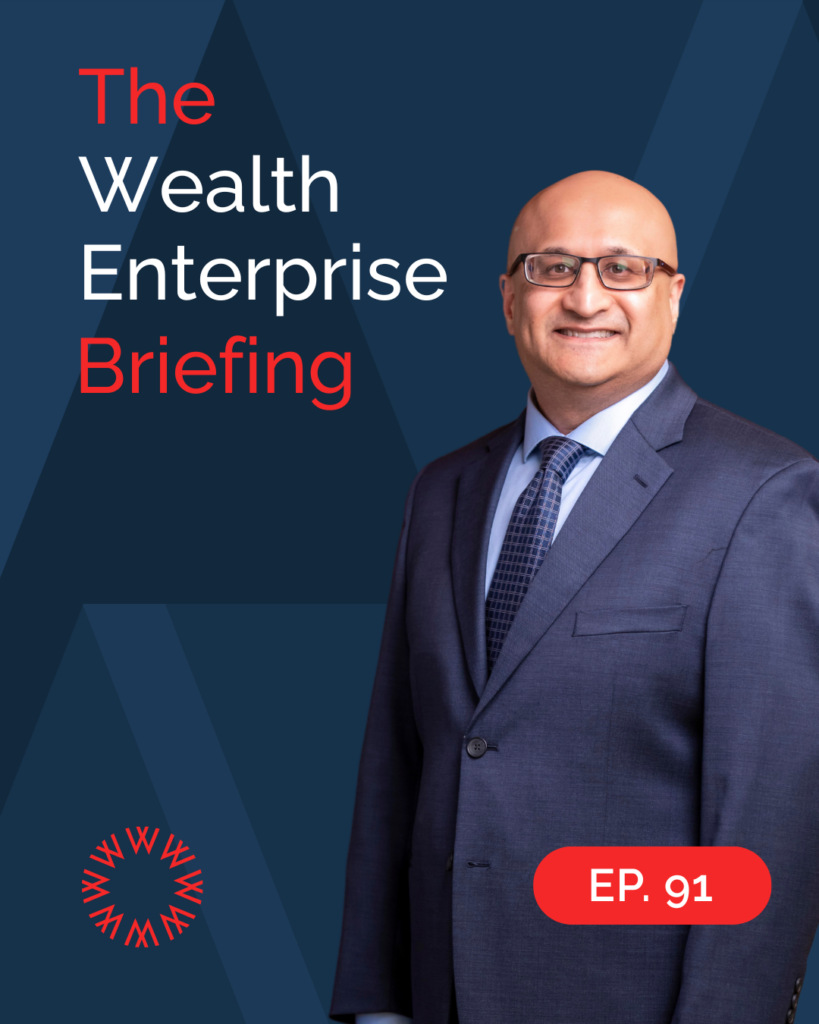
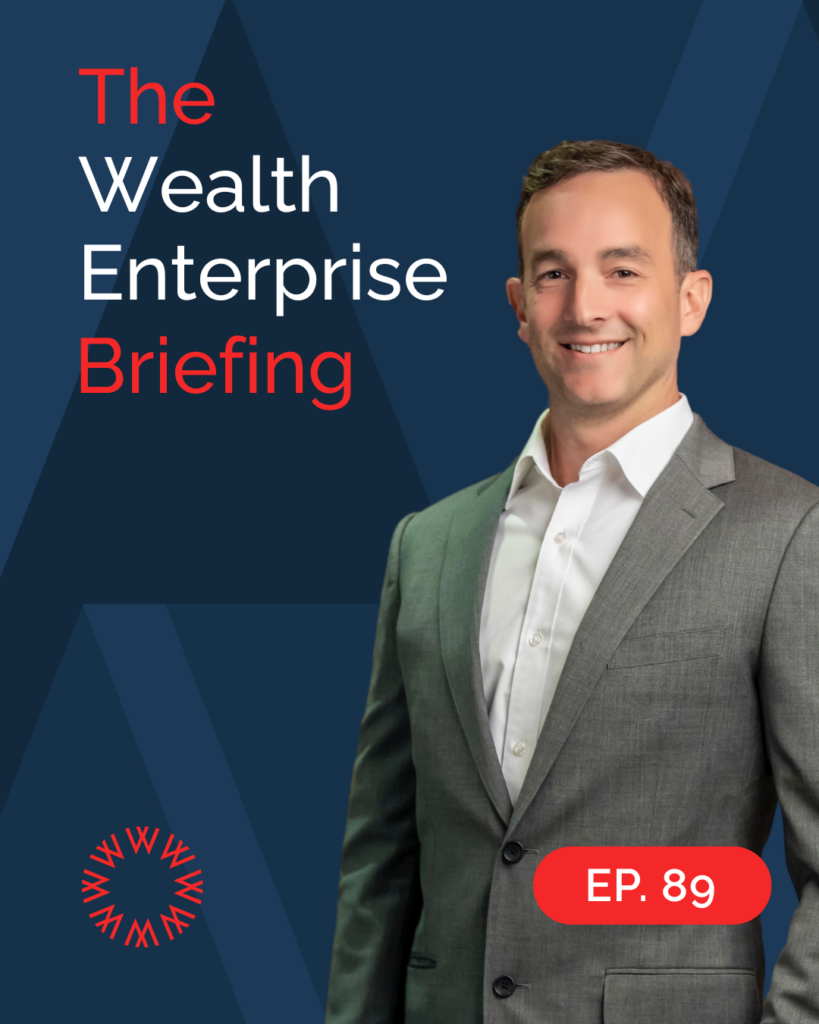
Michael Zeuner: 00:08
Hi everyone. This is Michael Zeuner, one of the managing partners at We Family Offices. Thanks for listening to The Wealth Enterprise Briefing. I’m joined today by Sam Sudame, our global head of macro, and we’re going to have a part two conversation about whether we’re in a bubble, particularly in AI stocks. And for those of you who listened, you may recall that Sam’s answer was a definitive No, and he explained why he’s a definitive No, particularly from his seat as a fundamental focused investor. And in a nutshell, I think the thesis was that so far, earnings are keeping up with the capital investment, and earnings are what’s driving the stock as less less sentiment and more fundamentals, we caution that what we could see in the future is a sentiment driven rally taking over, and that could, In fact, lead to a bubble, and it would be time to be thinking very carefully about those securities. What we want to talk about today goes one step past that and maybe pulls out our crystal ball and looks into the future, but learns a little bit from history, like we did last time. And you know, what strikes me is that even though we had these new technologies emerge, and I’m old enough to remember the.com bubble, and I think about the fact that things did get sentiment driven, and things did get out of hand in terms of valuations, and a bubble did form, and it spectacularly burst right in early 2000 having said that the internet was here to stay, irrespective of what happened to the valuations of some of those early movers in building out the internet. And I think that the internet had a profound effect, on an ongoing basis, on the economy, on efficiency, on productivity. And what I’d like to talk with Sam about today is same sort of analog with this AI revolution, whether we get into a bubble or not, you know, time will tell right whether sentiment takes over. I think history would suggest it’s likely that it could right, given all the other booms we’ve seen. But But beyond that, in terms of its impact on the broader economy and its impact on companies, you know, beyond the Magnificent Seven and the hyperscalers, is there an opportunity we should be thinking about now? And should we be layering in exposure, not just to the you know, sort of hyperscalers, but other companies that might benefit from Ai on a more fundamental basis. So Sam, with that long introduction, I will turn it to you, and we look forward to your perspective.
Sam Sudame: 02:52
All right. Thank you. Michael, so AI is a transformational technology, and we’re at the beginnings of this super cycle. But AI has multiple stages to it. The first stage is the building of the technology and the building, really, of that AI infrastructure. And we’re talking about the hyper scalers, the data centers. The next stage, I think, of this story will be companies that adopt the artificial intelligence programs to improve their productivity. That would be a stage two, which we’re just only, I think, starting. So the historical analog, and you’d mentioned about history. So again, in 2000 to 2002 the.com bubble burst, but then in tech stocks had a poor decade after that. Not to say that’s going to happen this time with the mag seven, but what did well after the.com burst were companies, particularly in the value arena, that were able to harness the power of the Internet to increase their productivity. That’s one of the think industrial companies. They were able to improve their inventory management. They were able to use this brand new technology to increase their productivity and therefore raise their profit margins and value stocks actually did very well from 2000 called 2002 to 2007 because they were then the beneficiaries of that revolutionary new technology. Today we see, you know, something like that can very much emerge, whereas, you know, it has been the mag seven time in the sunlight these last three years as they started building out the AI infrastructure. What could happen going forward is the baton being handed off to companies that adopt. Adopt and adapt AI to their own businesses. How do they apply it to their processes to make it more efficient and therefore lower costs? By lowering their costs, they raise their profit margins, and higher profit margins will be the key to that leg of the next stock market cycle, and we are actually probably just at the beginning stages of it. So when we looked at third quarter 2025 profit margins, it’s come in at the highest level in 25 years, and companies are just just now starting to use AI. Think this improvement in productivity will be the key.
Michael Zeuner: 05:47
So what we we have is this, sort of, clearly the early movers on the let’s call it the foundation side of AI, data centers, chip makers, hyper scalers, right? Are probably the three big examples. That’s what we’ve really been experiencing over the last couple of years in terms of valuation growth. And as we said earlier, we’re not seeing, you know, very clear signs of a bubble, although we are, we are watching for the fact that it could happen, that a bubble could emerge. But irrespective of whether one does or one doesn’t, there is then this next level set of impact, which is AI on all the other you know, 493 companies in the s, p5, 100 that your thesis is that AI will be transformative to those companies and help widen their margins. I’ve heard estimates from as much as, you know, one and a half to 2% which would be, you know, profound in terms of earnings growth and impact on the stock market. So again, I think that takes me back Sam. I want to test it with you, but that takes me back to saying as a long term investor, right having exposure to companies that today may not necessarily be a hyperscaler and benefiting from the melt up in valuations, but tomorrow might see their margins expand by one to 2% and obviously see their stock prices reflect that. Because it’ll be sustainable expansion, it’s important to have exposure to those companies as well. Do you agree with that?
Sam Sudame: 07:32
Yes. So you know, almost every company can adopt and adapt AI to their own businesses and therefore drive that higher productivity. And I think this is where a major difference between today and the.com during the.com companies, there were expectations that companies could use internet as a channel to drive more sales. Newly formed companies with new business models could find a way to build up their revenues using Internet. Today, that story is different. Today, that story is really a cost driven story. It is where for a business leader, trying to control their costs by understanding their processes is something they have a better handle over than trying to raise their revenue as was seen in the.com era. In other words, company management can better guide their own fates using AI than they did with the internet 25 years ago.
Michael Zeuner: 08:37
Yeah, and I remember Sam back to those days when people were talking about new valuation metrics the most you know. The best example of that being eyeballs, right? And companies were being valued on how many eyeballs they had on their websites, right, which is about as far away from fundamental investing as one could get, and as much of a signal of a bubble as anything right. When you create a new metric to drive valuation. I suspect that what you’re talking about with efficiency and margin growth, those are really fundamental metrics that investors have looked at for hundreds of years to value companies, and there’s nothing new about looking at earnings per share or, you know, net margin ratios, and watching that grow and having a positive impact on the valuation of the company.
Sam Sudame: 09:25
So it’s always important is what is driving those valuations? In the 1990s it was unrealistic assumptions about earnings really growing because of revenue growing a lot. In fact, there were expectations that the GDP growth rate would be extremely strong, more than what had been that actually was realized today. We’re not really seeing that today. It’s about cutting costs and not really about growing the GDP with these technologies.
Michael Zeuner: 09:55
Yeah, and I guess we, we would be wise to mention. That while we’re zeroing in on this call on valuations, around margins and fundamentals in the short term, there are many things that can affect the value of the stock market, including overall sentiment, as we’ve been talking about with the bubble, but I’m thinking about things like level of inflation, level of interest rates, confidence in us, governance, geopolitical affairs, right? A whole series of things that you know could play out independently of whatever happens with earnings. But as a long term fundamental investor, I presume that you sort of look through all of that and think about, hey, are these companies healthier? Are they delivering more profit? And at the end of the day as a shareholder, that’s what I’m expecting.
Sam Sudame: 10:49
So in the short run, it is sentiment, emotions that drive the stock market, on a very short term basis. That’s why we get all these whipsawing every day, but as you extend the time horizon, the positive emotions and negative emotions kind of wash out, and what is left over the long term are those solid fundamentals, which is why it’s very important to be a long term investor and not be swayed by these short term emotional swings in the market.
Michael Zeuner: 11:21
Okay, well, I think that’s a good place to leave it, Sam, those are wise words that we repeat often. So thank you, Sam, and we’ll look forward to talking again in the future.
Sam Sudame: 11:29
Thank you, Michael.
Disclosure: 11:33
The Wealth Enterprise Briefing is for informational and educational purposes only, and does not consider the specific investment objectives, financial situation or particular needs of any listener. The information in the briefing is not a recommendation of any security and should not be relied upon as investment legal or tax advice.