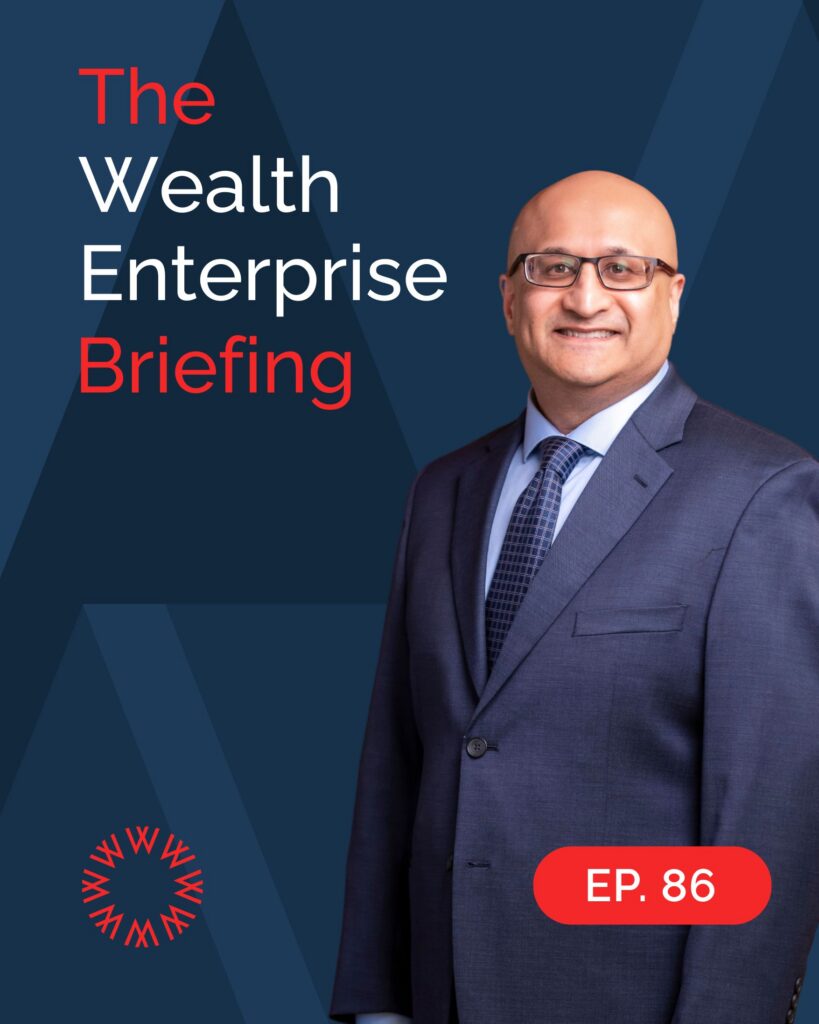
Michael Zeuner: Hi, everyone. I’m Michael Zeuner, Managing Partner at WE Family Offices. Thanks for joining us for another episode of the Wealth Enterprise Briefing. I’m joined today by a familiar voice, Sam Sudame, our Senior Investment Manager. Since this is our first podcast of the third quarter, we’re going to take a look back at what happened during the first half of the year and, more importantly, discuss our outlook for the second half and beyond. Sam, welcome. You and the investment committee recently published our latest Asset Class Highlights and Outlook, which centered on three key themes we believe are most important for investors today. First, despite the war, the energy price shock, tariffs, and other geopolitical challenges, we believe we’re in a reflationary growth phase of the economy. Second, we’re becoming more cautious on inflation and interest rates. The Federal Reserve has taken a more hawkish stance, which means rates may remain elevated for longer—and could even move higher. Third, we’re constructive on risk assets, including equities, infrastructure, alternatives, commodities, and natural resources. Let’s dive into each of those themes. One of the questions I’ve been hearing most from families is: The first half of the year was historic. Markets weathered geopolitical uncertainty remarkably well—but can this continue? Are we entering bubble territory? Sam, let’s start there.
Sam Sudame: Thanks, Michael. It’s great to be here. Looking back at the first half of the year, both the economy and the markets were hit by a significant energy shock that many viewed as stagflationary. Despite that, both remained remarkably resilient, and markets delivered a very strong first half. The primary driver of that resilience was the strength of the investment capital expenditure, or CapEx, cycle. That investment cycle is firing on all cylinders and, in our view, should continue. As we move into the second half of the year, I’m constructive. Geopolitical risks should gradually subside, the energy shock should continue to fade, and inflationary pressures should ease. At the same time, economic growth should remain well supported by this powerful investment cycle. That shift moves us from a stagflationary environment toward a reflationary one, which should continue to broaden the equity rally we began to see after the ceasefire in the Strait of Hormuz. Overall, a reflationary environment remains supportive of risk assets.
Michael Zeuner: Let’s unpack what you mean by a reflationary economy and why you’re confident that trend can continue. One concern many investors have is valuation. We’ve seen certain AI companies and semiconductor stocks rise 200% or 300%, and we’ve even seen AI companies come public at valuations approaching 100 times revenue. Those kinds of moves naturally raise questions. Can those valuations be sustained? And could they eventually spill over into the broader market? How are you thinking about those lofty valuations within this reflationary environment?
Sam Sudame: The first half of the year saw an exceptionally strong rally in semiconductor stocks—roughly 100% overall—because demand has been extraordinarily strong. Yes, share prices increased significantly, but they did so because revenues and earnings also increased significantly. Those gains were fundamentally driven. Overall, market sentiment remains fairly neutral. There are certainly speculative pockets. For example, some companies with extremely high valuations are pricing in technologies that haven’t yet been fully developed. Those valuations may reflect optimism and enthusiasm as much as current fundamentals. But across the broader market, sentiment remains balanced. Liquidity conditions are healthy, valuations are generally reasonable, and today’s price-to-earnings multiples are being supported by exceptionally strong returns on equity. In fact, earnings growth has been so strong that valuations have actually moderated in some areas because earnings have grown faster than stock prices. Overall, the fundamental building blocks remain very solid, anchored by strong corporate earnings.
Michael Zeuner: Ultimately, over the medium and long term, earnings are what drive the stock market. From what you’re saying, you’re seeing sustainable revenue growth, favorable macroeconomic conditions, and continued earnings growth. That’s before we’ve even fully realized the productivity gains that artificial intelligence could bring. What I also find interesting is the breadth of this earnings growth. It isn’t just concentrated in technology.
Sam Sudame: Exactly. Technology earnings remain very strong, but when we look across the S&P 500, eight of the eleven sectors are expected to generate double-digit earnings growth. The few sectors that aren’t tend to be slower-growing industries anyway. This isn’t simply a story about seven technology stocks anymore. It’s broad-based earnings growth across the economy. That was one of the biggest takeaways from the first half of the year. The S&P 500 gained roughly 10%, but mid-cap stocks outperformed large caps, and small-cap stocks outperformed both. In fact, small caps delivered their strongest first half in 35 years. That’s happening because earnings growth is even stronger among smaller companies. The investment CapEx cycle is lifting a much broader portion of the market.
Michael Zeuner: Let’s look at the other side of the equation. You’ve outlined a very constructive backdrop, but what could derail this outlook? As our chief macro strategist, what are you watching most closely?
Sam Sudame: The biggest risk I see is inflation. Earlier this year, higher gasoline prices were the primary inflation concern, and there’s an expectation that inflation will ease as oil prices fall back toward $70 per barrel. However, in a reflationary economy, stronger economic growth could keep inflation stickier than many expect. A healthy economy supports wage growth, increases demand for electricity and infrastructure, and reinforces many of the longer-term structural drivers of inflation. As a result, inflation may not decline as much as the market currently expects. That could keep the Federal Reserve more hawkish. At the beginning of the year, markets expected three rate cuts. Today, expectations have shifted dramatically, with some investors even discussing the possibility of one or two rate hikes. I’m not necessarily expecting rate increases, but I also don’t expect meaningful cuts. I believe rates are likely to remain higher for longer. That’s why we’re cautious about extending duration within fixed income portfolios. Investors can still earn attractive yields, but we don’t believe they need to take excessive interest-rate risk to do it.
Michael Zeuner: That’s exactly why we recently moved equities to an overweight position while maintaining a neutral stance on fixed income. A reflationary environment supports equities, but it also argues for being disciplined within bond portfolios. There are attractive opportunities in areas like high-yield credit and leveraged loans, but we’re remaining cautious about duration and generally favor maintaining maturities in the three- to five-year range. Sam, it sounds like you continue to see more opportunity than risk at this stage of the cycle. Of course, we’ll continue monitoring earnings, inflation, and the broader macroeconomic landscape closely. If those fundamentals change, our outlook will evolve as well. Thanks, as always, for sharing your perspective.